
Kilts For Men And Women
How to Measure Yourself for a Kilt: The Complete Sizing Guide
Oct
There’s a moment when you slip into a perfectly fitted kilt, your waist sits cleanly, the pleats fall just right, the fabric echoes heritage, but the cut says modern confidence. That moment is what we aim for at MenKilt. And it all starts with How to Measure Yourself for a Kilt: The Complete Sizing Guide. Too often, men rely on their pant size and assume it transfers to kilts.
But a kilt is a different garment altogether, where the waistband sits, how the pleats behave, and the length all combine to define the silhouette. When the measurement is off, the look suffers. At MenKilt, our handcrafted approach demands precision, not just for tradition, but for style. Whether you’re shopping our ready-to-wear collection or building your custom piece via our bespoke builder, the step you take now will improve comfort, movement, and aesthetics.
How to Choose the Right Fabric & Fit Before You Measure
Before you pick up the tape, let’s discuss fabric and cut, as how you wear your kilt affects how you measure it. Measuring for a kilt means understanding not only how to measure the kilt waist, but also why. At MenKilt, we offer handcrafted pieces in tartan wool, sturdy cotton blends, and modern utility fabrics, each carries its own fit behavior.
Why Fabric Affects Fit
A heavy wool tartan will drape differently from a lighter utility kilting fabric. With wool, you’ll want a firm waistband to ensure the kilt maintains its shape; with a softer fabric, you might allow a little more ease without compromising structure. Some utility styles include side-adjusters or Velcro, which give leeway, but your kilt measurements still need to be spot on. According to the kilt sizing guide, the waist is the anchor.
Fit Considerations Before Measuring
- Waist positioning: Decide where your kilt will sit, at the navel (traditional) or slightly lower/hip-level for a modern twist. This defines your measurement band.
- Seat/hip clearance: If your style includes room to sit and move (utility kilt, casual wear), you’ll want to measure around the broadest part of your bottom to confirm comfort.
- Length preference: Traditional kilts typically fall to mid-knee; modern styles may be shorter or longer, depending on your personal style. Knowing your ideal length will inform measurement.
- Adjustment allowance: Some kilts have strap adjusters; check whether you should order true size, size down, or up. One brand recommends ordering 2 inches below your waist measurement for the best fit.
Pre-Measurement Checklist
- Wear the shoes and socks you’ll likely pair with the kilt.
- Use a flat, soft tape measure and have a friend assist you, especially when taking the length measurement.
- Stand naturally with good posture, arms relaxed by your sides.
- Choose your waistband position (navel, just above, or hip) before taking the measurement.
Step-by-Step: Taking Your Measurements for a Kilt
Now we’re into the core: how to measure a kilt. At MenKilt, we rely on three measurements, waist, seat (hip), and length, to ensure fit and finish. Follow each step carefully.
Waist Measurement
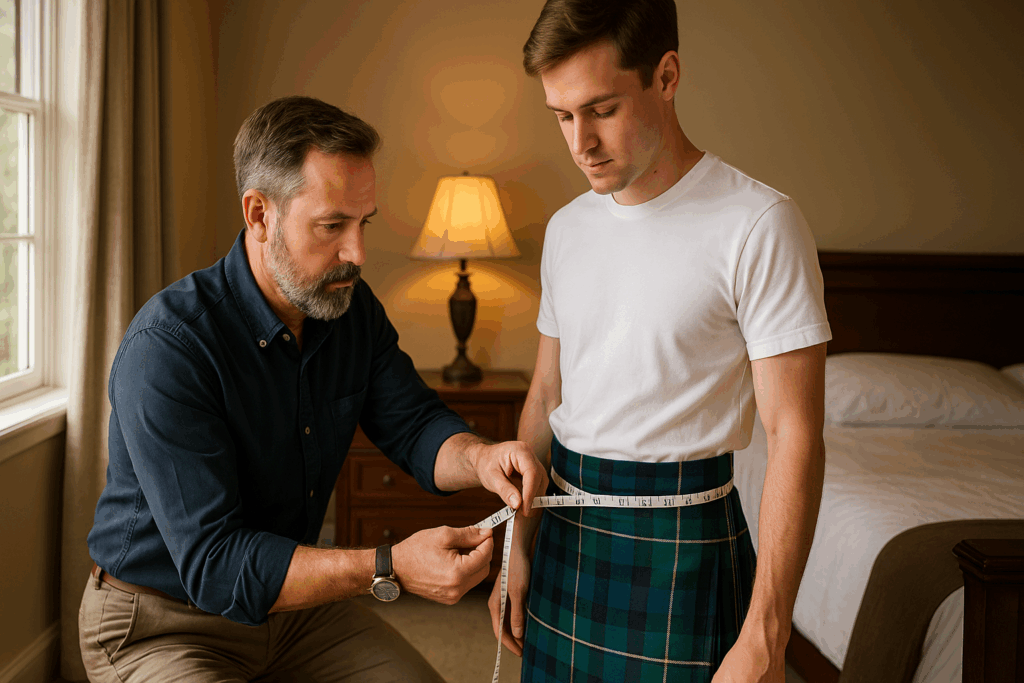
This is your primary measurement. Many kilts are sized by waist first.
- Stand upright with your feet together.
- Decide where your kilt waistband will sit (often around the navel or just above).
- Wrap the tape measure around that spot, keeping it parallel to the floor. Don’t suck in your stomach; stand relaxed.
- Pull it snug, but leave a finger’s width of space between the tape and your body, so it isn’t too tight.
- Write down: Waist = ___ inches.
Seat (Hip) Measurement
Especially relevant for custom or utility-style kilts, where the wrap and pleats around the waist must function smoothly.
- Stand with your feet together.
- Wrap the tape around the fullest part of your hips and buttocks, ensuring it’s straight across the front and back.
- Relax. Don’t pull tight.
- Write down: Seat = ___ inches.
Length Measurement
This determines where the hem of your kilt will fall, which is critical for both look and movement.
- Have someone measure for you. You can kneel on a chair (with your back straight and both feet flat on the floor) or stand, depending on the maker’s instructions. For example: “kneel and measure from your waist to the floor” for traditional length.
- From the waistband point (where you measured your waist) measure straight down:
- For traditional: around the middle of your kneecap.
- For modern/shorter: to just above the knee.
- Write down: Length = ___ inches.
Final Checklist & Tips
- Double-check all three kilt measurements for consistency.
- Label: Waist ___ / Seat ___ / Length ___.
- If you’re ordering from MenKilt, please reference these options in our custom kilt builder (link to MenKilt custom kilt builder).
- If you’re between sizes:
- Traditional wool style? Consider sizing slightly smaller so the waist sits firmly.
- Utility style with adjusters? You may size up for comfort. One guide recommends ordering the size you measure for utility kilts, unless they specify otherwise.
- Keep your measuring tape handy; future reorders or accessory fits rely on it.
Modern Ways to Style Your Kilt & Why Fit Matters
A great measurement is one thing; how you wear your kilt is another. Knowing how to style it and understanding the role of fit elevates the garment from costume to wardrobe pivot.
Why Fit Affects Style
- A properly measured waist ensures the kilt sits where you want, so pleats flow and fabric hangs correctly, not riding up or drooping.
- If the waistband is too loose, the kilt can slip or the drape becomes sloppy, negating the sharpness of handcrafted tailoring.
- The length influences visual balance: too short disrupts polish; too long can look outdated or unbalanced. A standard guide states mid-knee is ideal for traditional length.
- The seat measurement affects how the back wraps your body; a poor fit there means tugging or distortions in pleats when you sit or move.
At MenKilt, we honor both heritage and modern execution. When you follow the measurement steps and style intentionally, you’re not just wearing a kilt, you’re wearing a statement that fits body, purpose, and lifestyle.
Frequently Asked Questions
Can I choose a shorter length for a more modern look?
Absolutely. While traditional kilts typically fall to the midpoint of the kneecap, many modern styles drop just above the knee or even slightly shorter. According to a sizing reference, shorter lengths are acceptable for modern interpretations, but always measure from your chosen waistband height to ensure a correct fall.
What if I’m between kilt sizes after taking the measurement?
It depends on style and adjustability. For traditional wool kilts (with fixed straps), sizing slightly down may give a firmer fit and better drape. For utility kilts with Velcro or an extensive adjustment range, sizing up can provide comfort without losing structure.
How do I measure if I don’t have access to the person for measuring?
While direct measurement is best, if you’re gifting a kilt you can use this workaround: take the person’s pants and measure the waistband with the pants laid flat, then add 2–4 inches depending on fit and style, because kilt measurement should be larger than pants size according to many makers.
What should I check to ensure the kilt fits correctly?
Put the kilt on with your usual shoes and socks. Stand and walk. Sit down. Check that the waistband sits where you measured it, that it doesn’t dig or hang loosely, that the pleats fall evenly, and that the hem falls at the length you requested.
Conclusion
Mastering how to measure for a kilt is more than a detail; it’s the foundation of how your kilt will look, feel and perform. The three key numbers (waist, seat, length) unlock a fit that lets you move with confidence, wear with intention, and invest in a garment that stands out. At MenKilt, our commitment to craftsmanship, style, and fit means we deliver accurately when you measure accurately.